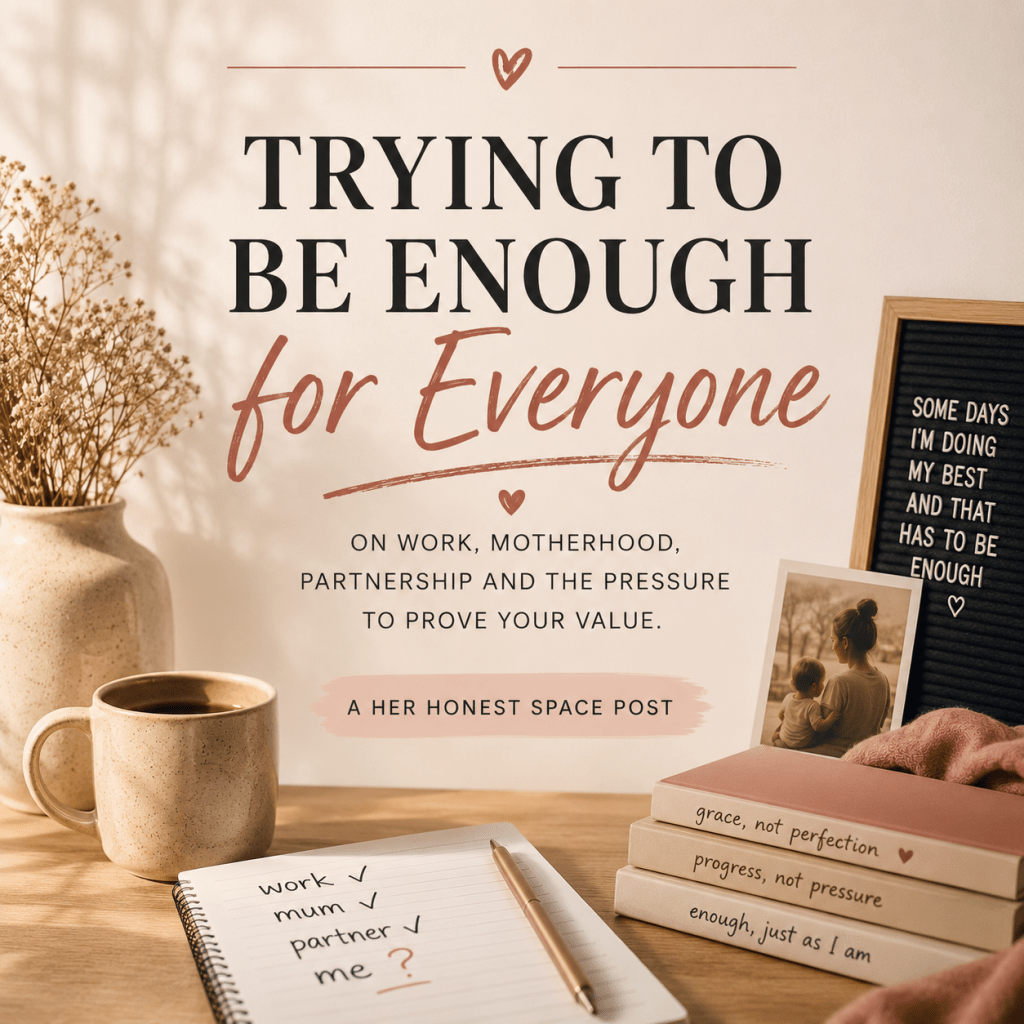
A personal reflection on balancing work, motherhood and partnership while questioning how much of our worth becomes tied to productivity, income and contribution.
I only work three days a week. To some people, that probably sounds manageable. Maybe even balanced. But what people don’t always see is that some jobs don’t stay neatly within rostered hours.
Mine is physically demanding, mentally exhausting, and creative all at once. I genuinely love what I do, but I also care deeply about doing it well. I’m a perfectionist by nature. I notice details, I want things done properly, and I struggle to walk away from unfinished work. Because of that, I often stay back to finish what needs to be done. The frustrating part is that those extra hours aren’t overtime. They’re “hours owed” that I rarely get back.
People often say, “Just leave it for tomorrow.” But my job doesn’t really work that way. The work has to be completed there. Deadlines don’t disappear because I’m a mum, and responsibilities don’t pause because I’m tired. By the time I get home, I’m exhausted. Not the kind of tired that a quick rest fixes, but the kind where you’ve spent the entire day solving problems, making decisions, lifting, moving, creating and thinking for everyone else. Yet motherhood doesn’t stop because you’re exhausted. Your child still needs you, your partner still needs you, and the house still needs you. There is no breather waiting when you walk through the door.
The hardest part isn’t the overtime. It’s feeling guilty no matter what choice I make. If I leave work on time, I feel like I’m letting my team and my responsibilities down. If I stay back, I feel like I’m letting my family down. Either way, I feel like I’m falling short somewhere.
My partner and I made an agreement around childcare. On those days he does drop-off and I do pickup. If I’m honest, I’ve always struggled with that arrangement more than he realises. My work doesn’t come home with me. What isn’t finished at work stays unfinished. On childcare days, I’m constantly watching the clock, calculating traffic, trying to squeeze one more task in before I leave, while knowing there is a hard deadline I can’t miss. Some days it feels like I’m failing before I’ve even left work. When I know I’m not going to make it, I ask for help. That’s often when the frustration begins.
To be fair, I don’t think my partner is intentionally trying to make me feel this way. From his perspective, he’s carrying a larger financial responsibility for our family and the pressure that comes with that. I can understand why unpaid overtime looks frustrating when viewed purely through a financial lens. But understanding his perspective doesn’t make my own feelings any less valid. Sometimes two things can be true at once. He can be carrying financial pressure, and I can be carrying the pressure of trying to prove that my contribution matters too.
The truth is, I stay part-time because I want those extra days with my son while he’s young. I don’t want to miss these years. I don’t want to wake up one day and realise I spent all my time working while he was growing up. But I also don’t want to lose myself completely. I want to be present for my son and still have a career that challenges me, fulfils me and allows me to be creative.
I could work full-time. Financially, it would probably make more sense. But every time I think about it, I come back to the same thing: my son is only little once. I can earn more money later. I can’t get these years back.
Sometimes it feels like society expects mothers to choose between the two, as though wanting both is somehow unreasonable.
There is another layer to this that I don’t think gets talked about enough. When you’re not the breadwinner, it can sometimes feel like your work carries less value. Not always directly and not always intentionally, but when one person’s income is significantly higher and they pay for more financially, it can create an unspoken hierarchy where their contribution feels more important. The message isn’t usually said outright. It’s implied. Their work is seen as the priority because it brings in more money, while yours becomes the supporting act. The income that helps with the bills rather than the income that carries the household.
What people don’t talk about is how easy it is to tie your worth to your income. The higher earner becomes the provider. The lower earner can quietly start feeling like they need to justify their career, their time and even their exhaustion.
Over time, that can make you question the value of your own work. It can make you feel like your stress isn’t as valid, your deadlines aren’t as important and your sacrifices don’t carry the same weight. But contribution isn’t measured only in dollars. A family’s success isn’t built solely on the highest income. It’s built on the childcare pickups, the mental load, the planning, the emotional support, the household tasks and all the invisible sacrifices made behind the scenes.
Sometimes, when both parents are exhausted, conversations turn into scorecards. “I did this.” “What did you do?” Suddenly you’re no longer teammates. You’re two tired people trying to prove who is carrying more. I’ve been there. I’ve felt the frustration of wanting my effort to be seen, wanting my contribution to matter even if it doesn’t come with the biggest paycheck. Because my work matters. My role as a mother matters. My role as a partner matters. None of them should have to compete with each other.
I don’t have the answers. I don’t know how to perfectly balance work, motherhood, partnership and my own sense of identity. What I do know is that writing this has made me realise how much of my worth I’ve tied to being productive, helpful and needed. Maybe the challenge isn’t doing more. Maybe it’s learning that my value exists even when I can’t be everything to everyone.









Leave a Reply